Yesterday we started electrophilic aromatic substitution reactions, or EAS. The concept was generally this -- benzene is pretty unreactive as a Lewis Base, so in order to get it to react we need to increase the Lewis Acidity of the other reagent. This we did by using a separate Lewis Acid (with halides it was an iron halide) to put a positive charge on one of the halogen atoms (just like protonating -OH to make it water). We also saw that the carbocation intermediate, although losing stability due to loss of aromatic character, is somewhat stabilized by resonance. The reaction is finished off by deprotonation to regenerate the aromatic character of the ring.
A key for the exam has been posted to the left.
Thursday, April 26, 2007

Monday, April 23, 2007
Exam #4!
In case you weren't paying attention, we had an exam today. I hope that it went well for you.
Thursday, April 19, 2007
Keys added!
Keys for last year's exam and the Molecular Orbital problem set have been added to the left.
Wednesday, April 18, 2007
Diels-Alder Reaction and MMO (More Molecular Orbitals!)
Today was a hard day. We spent the first part going over one way to figure out the structures of molecules when give spectral data; I did problem #2 from the ND web site. The due date for the group NMR problems was moved back to NEXT Friday.
We looked at the Diels-Alder reaction -- a way to make cyclohexenes from a diene and a dienophile (which is generally a fancy name for an alkene). Since there is no obvious Lewis acid and Lewis base, the generic curved arrow formalism has even less meaning than normal, even though we can still use it to figure out what the product looks like. A better approach is to look at the HOMO and LUMO of the reactive species and see if the HOMO of one will overlap with the LUMO of the other in such a way that the phases match up on both sides. We saw that this does work for the Diels-Alder reaction but won't for other similar reactions (for instance the reaction between two equivalents of diene to make a cyclooctene). This makes it imperative to learn how to draw molecular orbitals for any of the relatively short-chain alkenes or polyenes (ethenes, dienes, trienes).
I have added a Molecular Orbital problem set on the left. I'll get a key ready for that (and for last year's exam) done ASAP.
We looked at the Diels-Alder reaction -- a way to make cyclohexenes from a diene and a dienophile (which is generally a fancy name for an alkene). Since there is no obvious Lewis acid and Lewis base, the generic curved arrow formalism has even less meaning than normal, even though we can still use it to figure out what the product looks like. A better approach is to look at the HOMO and LUMO of the reactive species and see if the HOMO of one will overlap with the LUMO of the other in such a way that the phases match up on both sides. We saw that this does work for the Diels-Alder reaction but won't for other similar reactions (for instance the reaction between two equivalents of diene to make a cyclooctene). This makes it imperative to learn how to draw molecular orbitals for any of the relatively short-chain alkenes or polyenes (ethenes, dienes, trienes).
I have added a Molecular Orbital problem set on the left. I'll get a key ready for that (and for last year's exam) done ASAP.
Tuesday, April 17, 2007
Dienes

Yesterday was the first day to talk about 1,3-dienes. We covered two major topics -- first was a treatment of the molecular orbitals that come into play with dienes. There are four molecular orbitals (conservation of orbitals as we can think of them as being derived from the four p-orbitals of the pi-system) and the two lowest in energy each contain a pair of electrons. The two higher energy orbitals are not populated by electrons. We also identified the HOMO and LUMO, and discussed the concept of phases in orbitals. All of this was (hopefully) reinforced by showing the orbitals of cyclopentadiene, as determined by Spartan.
The second topic was the addition of HBr to a diene. We saw the possibility of two products and determined how to tweak the conditions (temperature) to allow us to get the kinetic or thermodynamic product.
The picture is of the four molecular orbitals of a diene, just as we discussed in class. It should expand if you click on it.
Friday, April 13, 2007
Spectroscopy -- Done!
Today was the end of NMR and we discussed multiplicity. We say the theoretical basis of the "N+1 Rule" and looked at a bunch of examples. The main point was essentially this: The integration is an indicator of how many hydrogens are responsible for the resonance and the multiplicity is an indication of the number of hydrogens on adjacent carbon atoms. We saw singlets, doublets, triplets and quartets. Complicated cases, where two or more different (non-equivalent) sets of hydrogens were nearby, led to multiplets.
We looked at the problem set and the 11 pages of the problem set key and saw the on-line problem set from Notre Dame (link at left). Each group, in lieu of a mash-up, is to give me the answers to the 12 listed problems by next Friday. Help each other!
We looked at the problem set and the 11 pages of the problem set key and saw the on-line problem set from Notre Dame (link at left). Each group, in lieu of a mash-up, is to give me the answers to the 12 listed problems by next Friday. Help each other!
Thursday, April 12, 2007
1H NMR
Yesterday was a continuation of NMR, except we looked at the NMR of hydrogen rather than carbon. The concepts are the same, with an exception or two.....the main difference that we saw was that there is a quantitative aspect to 1H NMR that is not present in 13C NMR. It is possible to do an integration of the peaks, which will give us a relative ratio of the number of hydrogens responsible for each signal. Yesterday, all of the peaks were single peaks, on Friday we will look at how peaks can have different multiplicities -- there was some foreshadowing when I mentioned the N+1 Rule at the end of class.
Many changes have been made to the left: The Need to Knows for Chapters 13, 14 and 15 have been posted, as have the charts for 13C and 1H NMR. (Remember, you'll be given the 13C chart but must learn the 1H chart.) Modeling exercise #10 has also been posted; I'll talk more about it tomorrow.
New changes! A key for the exam and an NMR problem set have been posted. The problem set key will be posted once I get it cleaned up a bit and I'll have a group NMR activity for you tomorrow.
Many changes have been made to the left: The Need to Knows for Chapters 13, 14 and 15 have been posted, as have the charts for 13C and 1H NMR. (Remember, you'll be given the 13C chart but must learn the 1H chart.) Modeling exercise #10 has also been posted; I'll talk more about it tomorrow.
New changes! A key for the exam and an NMR problem set have been posted. The problem set key will be posted once I get it cleaned up a bit and I'll have a group NMR activity for you tomorrow.
Monday, April 09, 2007
NMR
Today we started NMR spectroscopy. We covered the basics of 13C NMR and were exposed to some basics: upfield and downfield, shielded and deshielded, TMS, ppm, etc. The major point was that every unique carbon atom will have a resonance peak in a 13C NMR spectrum. This means that the most important thing that a student must worry about is determining how many unique carbon atoms are in a compound.
We also looked at two special 13C NMR experiments, DEPT-90 (only shows CH's) and DEPT-135 (shows CH and CH3 peaks pointing up, CH2 peaks pointing down).
We also looked at two special 13C NMR experiments, DEPT-90 (only shows CH's) and DEPT-135 (shows CH and CH3 peaks pointing up, CH2 peaks pointing down).
Thursday, April 05, 2007
IR Spectroscopy
Today we finished our short tour of MS and IR by looking at the basics of infrared spectroscopy. We reduced it down to a half-dozen or so types of bonds that will show up at different portions of the IR spectrum. It is anticipated that you will learn those areas and be able to draw IR spectra of simple molecules, including labels on the axes.
A key to last year's exam has been posted.
A key to last year's exam has been posted.
Monday, April 02, 2007
Spectroscopy

Today we started our treatment of spectroscopy by looking at mass spectroscopy (MS). MS is used by organic chemists primarily as a first look at a compound's molecular weight by observing the molecular ion peak. It is also valuable as a method for determining structure by looking at fragmentation patterns -- a molecule is ionized by bombarding it with an electron beam and the resultant radical cation then fragments into smaller particles. These particles can be detected provided they have a charge. We saw a limited number of fragmentations for which you will be responsible, including alpha cleavages, dehydrations and McLafferty rearrangements.
A new problem set and key has been posted. Last year's exam has also been posted.
The picture is of Asa Larson. He studies the process of an electron recombining with a molecular ion (the reverse of the step that starts MS) in his work at the Royal Institute of Chemistry in Stockholm, Sweden.
Thursday, March 29, 2007
Even More Additions to C=C !!!!

We can't get enough of this addition of various species to alkenes. Yesterday was pretty much the final installment -- addition of H2, ozonolysis and di-hydroxylation were examples of reactions that we just have to know, without mechanistic details. One reaction in which the mechanism is approachable was the radical synthesis of some classes of polymers (we used polystyrene as an example).
A new podcast has been posted. It is a short-form of generic additions of various electrophiles to alkenes.
The image is that of an ozone generator. It is similar to the one that I used to destroy the rubber tubing many years ago.
Tuesday, March 27, 2007
More Alkenes as Nucleophiles
We've continued to look at alkenes as nucleophiles but we have made the electrophiles more complicated than simple HX. Our examples of electrophiles include X2, Hg(OAc)2 and BH3. In those cases, we use available electrons to swing back down to the developing carbocation and eliminate the positive charge on the carbon. In the case of BH3, this is relatively straight forward and takes us to a product in which we have added H-BH2 across a C=C. In the other two cases we make a three-membered ring with a positive charge and we must open the ring by reaction with a nucleophile. Note that the nucleophile must attack the three-membered ring from exactly the opposite side of the leaving group (Br or Hg), so there can be stereochemical implications.
Thursday, March 22, 2007
Alkenes as Lewis Bases/Nucleophiles

Yesterday we looked at how alkenes can react as nucleophiles. The reasoning behind this activity is due to the fact that the pi electrons are not trapped between the nuclei, as are electrons in a sigma bond, but are out in a more open space (remember--side to side overlap of the fat parts of p-orbitals). As a result, the pi electrons can act somewhat like a lone pair of electrons.
The reaction that we looked at was the reaction of alkenes with HBr. It is a two-step process, leading to an intermediate cation which is then attacked by the generated bromide ion. The entire process is just the reverse of an E1 reaction.
The regiochemistry of the reaction is governed by Markovnikov's Rule -- the cation formed is the more stable of the two possibilities. Note that the intermediate cation has an unhybridized p-orbital so the bromide can attack from either side; this can have implications for stereochemistry.
Problem Set 7 and its key have been added to the list of useful links. At this point, we have only covered how to do reaction series (a).
The picture is of Vladimir Markovnikov.
Tuesday, March 20, 2007
Alkenes
Yesterday was a day to start talking about alkenes. We spent most of the time discussing the physical chemistry of the C=C bond -- how it consists of an end-to-end bond and a side-to-side pi bond. I used the example of a pair of forearms and showed how they had to be parallel in order for the bond to exist; as a result it is nearly impossible to rotate around a C=C bond. We also saw the basis for Zaitsev's rule. Essentially, it is hyperconjugation that is responsible for the increased stability of more highly substituted alkenes. At the end, we saw a foreshadowing of the chemistry that we will discuss, the ability of the alkene to act as a Lewis base.
Modeling #7 has been posted; molecule slips will be available tomorrow.
Modeling #7 has been posted; molecule slips will be available tomorrow.
Monday, March 12, 2007
New Postings
I've added the key to exam 2, along with Need to Know links for Chapters 6, 7, 8, and 12. I hope your spring break is off to a great start!
See you next Monday.
See you next Monday.
Monday, March 05, 2007
Work, work, work!
Today we worked pretty hard on being able to determine which reactions are possible for a given set of conditions. All of this is based on looking at the Lewis acid (the compound with the leaving group) and the Lewis base (the nucleophile or base). Once the determination is made which reaction(s) is/are possible, all that remains is to draw the arrows.
We will continue to practice drawing reactions on Wednesday.
We will continue to practice drawing reactions on Wednesday.
Saturday, March 03, 2007
Some Additions to the Links......
Friday, March 02, 2007
Elimination Reactions
Today we covered both the E1 and E2 reactions. In both cases, we use a Lewis base to abstract a proton from the substrate (at a carbon next to the carbon with the leaving group) and form an alkene. There are differences, however: The E2 is a single-step reaction and the stereochemistry of the product is determined at the beginning of the reaction. The E1 reaction is two steps and the presence of the intermediate allows for C-C bond rotation, therefore the stereochemistry is not set until the second step of the reaction.
We started to look at how to determine which of the four possible reactions (SN1,SN2, E1, E2) would take place under a particular set of reaction conditions, with the promise of more to come next Monday and Wednesday.
Over the weekend a copy of last year's exam will be posted, along with a podcast of the material from today's lecture and an elimination problem set. I am also hoping to get some more substitution problems posted to give you more practice with drawing arrows.
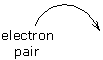
The picture shows what it is all about -- a pair of electrons is moved according to the direction of an arrow, from Lewis base to Lewis acid.
Wednesday, February 28, 2007
SN1!!!
Today we talked about the SN1 reaction, the second of our two substitution processes. There are significant differences between the SN1 and the SN2 reaction: in terms of stereochemistry, an SN1 gives racemization instead of inversion, for steric bulk it is better to have a highly substituted substrate for an SN1 reaction (instead of an accessible carbon like we needed for the SN2), etc. It is important to be able to recognize the difference in energy profiles for the two reactions -- an SN1 is two steps and an SN2 is one step.
There is also a major difference in solvent requirements: in an SN2 reaction, polar protic solvents surround and stabilize the negatively charged nucleophile, slowing the reaction. In an SN1 reaction, you must have a polar protic solvent to stabilize the intermediate carbocation otherwise the energy level is too high and the reaction will not take place.
The podcast for today's lecture has been posted and is available on iTunes. In iTunes, go to Advanced > Subscribe to Podcasts, then enter this URL: http://itech.dickinson.edu/blog/?feed=rss2&cat=765
On Friday I hope to cover both elimination reactions, allowing us to spend next Monday and Wednesday working problems in preparation for Friday's exam.
There is also a major difference in solvent requirements: in an SN2 reaction, polar protic solvents surround and stabilize the negatively charged nucleophile, slowing the reaction. In an SN1 reaction, you must have a polar protic solvent to stabilize the intermediate carbocation otherwise the energy level is too high and the reaction will not take place.
The podcast for today's lecture has been posted and is available on iTunes. In iTunes, go to Advanced > Subscribe to Podcasts, then enter this URL: http://itech.dickinson.edu/blog/?feed=rss2&cat=765
On Friday I hope to cover both elimination reactions, allowing us to spend next Monday and Wednesday working problems in preparation for Friday's exam.
Monday, February 26, 2007
SN2!
Today was a day to learn about SN2 reactions. We pretty much covered it all, from nature of the mechanism to requirements for nucleophiles, leaving groups, substrates, and solvents. A few big points: There is only a single step (no intermediate) and the stereochemistry at the carbon of interest is inverted (the phenomenon is called a Walden inversion). On Wednesday we'll cover the other major substitution reaction, the SN1 (which, confusingly enough, has two steps).
Today's graphics have been assembled into a seven-minute podcast; it will be posted on Tuesday morning and will be available on iTunes.
Today's graphics have been assembled into a seven-minute podcast; it will be posted on Tuesday morning and will be available on iTunes.
Subscribe to:
Posts (Atom)